
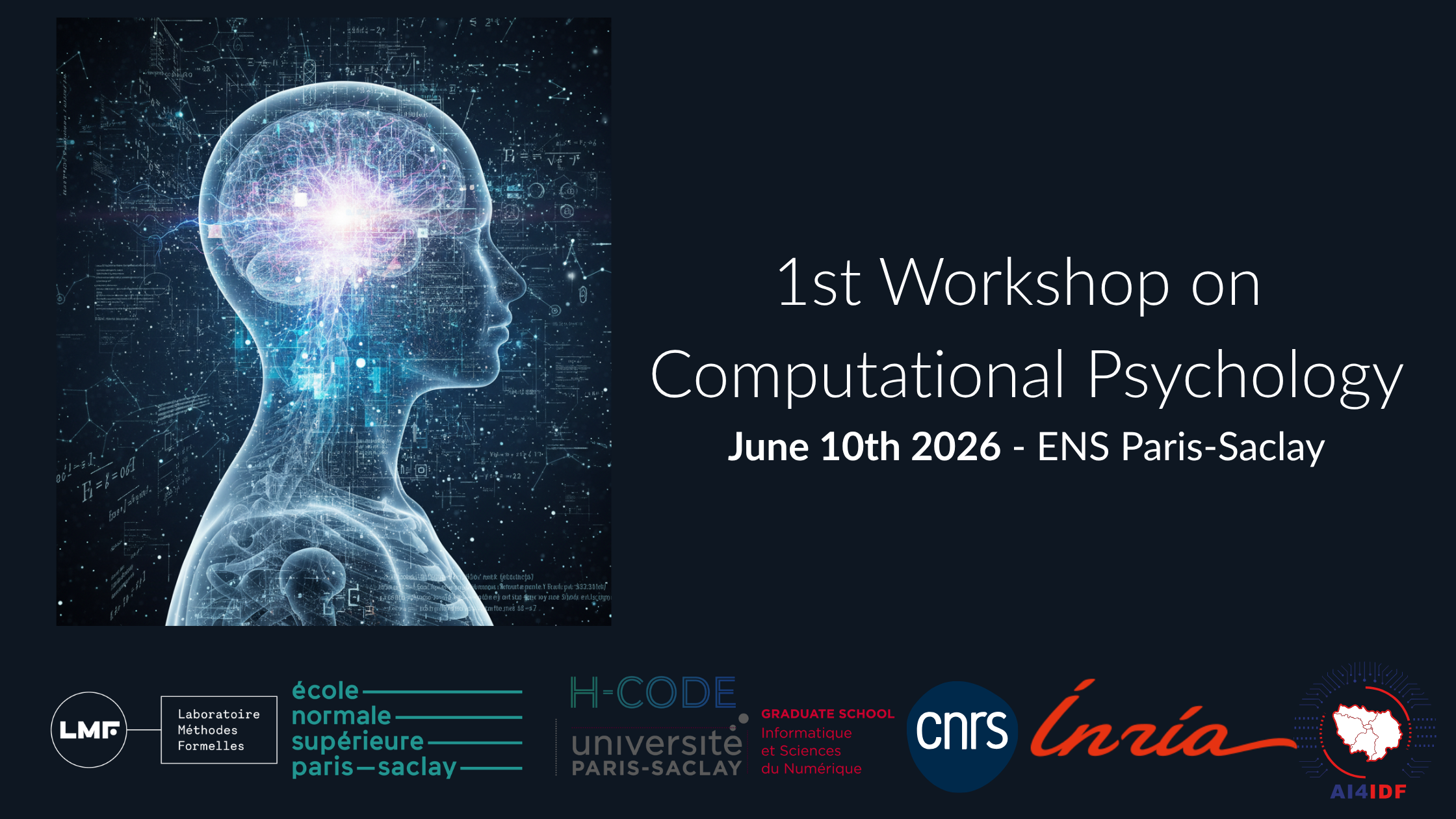
Computational Psychology : A Theoretical Framework
Computational Psychology is an interdisciplinary framework that formalizes psychological processes through explicit computational structures. Situated at the intersection of theoretical psychology, computer science, and data science, it seeks to transform psychological theories into well-defined systems capable of simulation and empirical testing.
A central idea of Computational Psychology is that psychological theories can be made more explicit and testable when expressed as computational models capable of generating observable behavioral trajectories. Within this framework, mental phenomena are conceived as dynamic information-processing systems, representable at multiple levels of abstraction (symbolic, probabilistic, connectionist, or dynamical).
The field is structured around three axes:
- the algorithmic formalization of cognitive and behavioral theories using automata, networks, and dynamical systems
- the analysis of complex psychological data through machine learning and computational methods
- the modeling of digital behavior and human–machine interaction as coupled dynamic systems
Computational Psychology therefore promotes the development of computational models that explicitly represent psychological mechanisms and can be simulated and tested against empirical data.
Invited Speakers
We are pleased to welcome the following invited speakers:
- Céline Clavel (LISN, Université Paris-Saclay)
- Jill de Ron (University of Amsterdam)
- Gaspard Fougea (LMF, ENS Paris-Saclay)
- Jean-Claude Martin (LISN, Université Paris-Saclay)
- Steven Pinker (Harvard University) (to be confirmed)
- David Rudrauf (F2S, Université Paris-Saclay)
- Rufin VanRullen (CerCo, CNRS, Université de Toulouse)
Registration
Attendance is free but mandatory and subject to approval. Applicants will receive a response within 1 week.
Application to attend deadline: May 4, 2026
Poster Submission
Participants are invited to submit a poster. Poster submissions will be reviewed. Authors will be notified within 2 weeks.
Poster submission deadline: May 4, 2026
Organizers & Scientific Committee
- Eric Artiges, Centre Borelli, ENS Paris-Saclay
- Frédéric Boulanger, LMF, Centrale-Supélec
- Raphael Faure, LMF, ENS Paris-Saclay
- Alain Finkel, LMF, ENS Paris-Saclay
- Gaspard Fougea, LMF, ENS Paris-Saclay
- Amine Haddou, LMF, ENS Paris-Saclay
- Lise Haddouk, Centre Borelli, ENS Paris-Saclay
- Jean-Claude Martin, LISN, Université Paris-Saclay
- David Rudrauf, F2S, Université Paris-Saclay
- Nicolas Sabouret, LISN, Université Paris-Saclay
- Grégoire Sergent-Perthuis, CQSB, Sorbonne Université
- Lina Ye, LMF, Centrale-Supélec
Related workshops
Modeling Psychological Theories with Finite Automata
June 12 In Person, June 16th online
Training session at ENS Paris-Saclay introducing a computational framework to translate verbal psychological theories into formal models using tools from theoretical computer science. Participants will learn how to formalize concepts from their own research and build models through stepwise refinement.
Click here for more information
4th Paris Workshop on Game Theory and Language: Half a Century of “Agreeing to Disagree”
June 11–12
Workshop at Université Paris-Panthéon-Assas marking the 50th anniversary of Robert Aumann’s Agreement Theorem. The event focuses on common knowledge, belief modeling, and extensions of the theorem, with interdisciplinary contributions from economics, computer science, psychology, philosophy, and linguistics.
